 Maxim
Maxim When it comes to web scraping, social media automation, ad verification, or bypassing geo-restrictions, choosing the right proxy type is critical. Two of the most powerful options available today are mobile proxies and residential proxies.
While they may seem similar at first glance, they serve different purposes and offer distinct advantages.
In this guide, we’ll break down:
- What mobile proxies are
- What residential proxies are
- Key differences between them
- Use cases for each
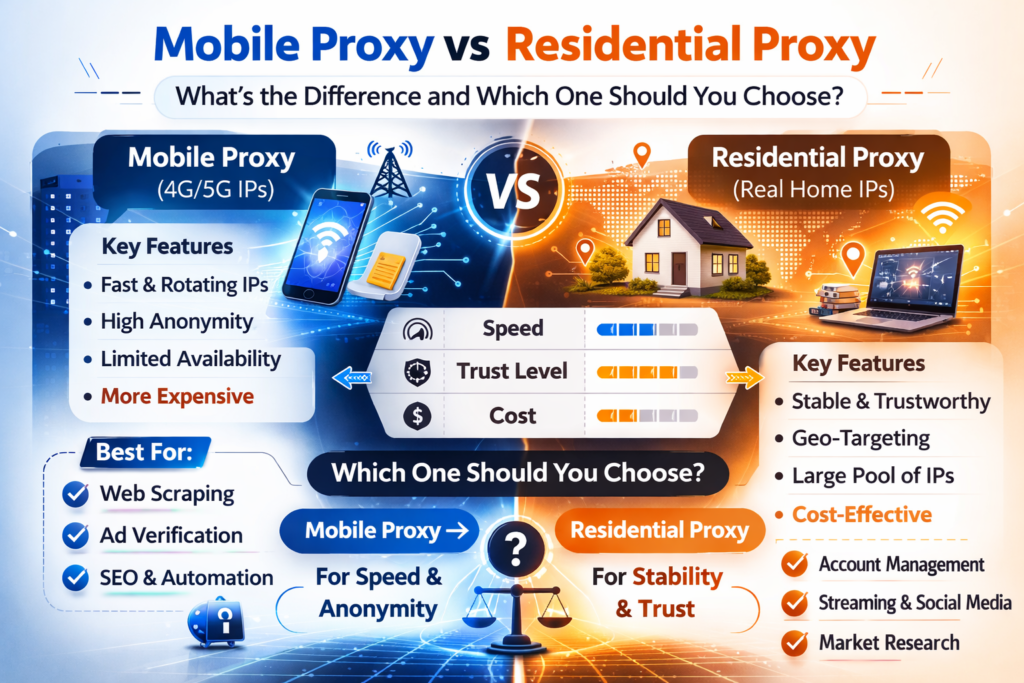
Mobile Proxy vs Residential Proxy
Understand the differences, best use cases, and which proxy type to choose.
What Is a Residential Proxy?
A residential proxy routes your internet traffic through real IP addresses assigned by ISPs to homeowners. Your connection appears as if it’s coming from a regular household user.
Key Characteristics:
- IPs belong to real residential devices
- Assigned by ISPs
- Rotating or sticky sessions
- Large IP pools
- More affordable than mobile proxies
Best Use Cases:
- Web scraping
- Market research
- SEO monitoring
- Price comparison
- Ad verification
- Managing multiple accounts
What Is a Mobile Proxy?
A mobile proxy routes your traffic through real mobile devices connected to cellular networks (3G/4G/5G). Your traffic appears as if it’s coming from a real smartphone.
Key Characteristics:
- IPs assigned by mobile carriers
- Shared IP ranges (CGNAT)
- Very high trust score
- Smaller IP pool
- More expensive
Best Use Cases:
- Social media automation
- High-trust account management
- Affiliate marketing
- High-risk automation
- Bypassing strict anti-bot systems
Key Differences
| Feature | Residential Proxy | Mobile Proxy |
|---|---|---|
| IP Source | ISP home users | Cellular carriers |
| Trust Level | High | Very High |
| Cost | Moderate | Expensive |
| IP Pool Size | Large | Small |
| Detection Risk | Low | Very Low |