 Maxim
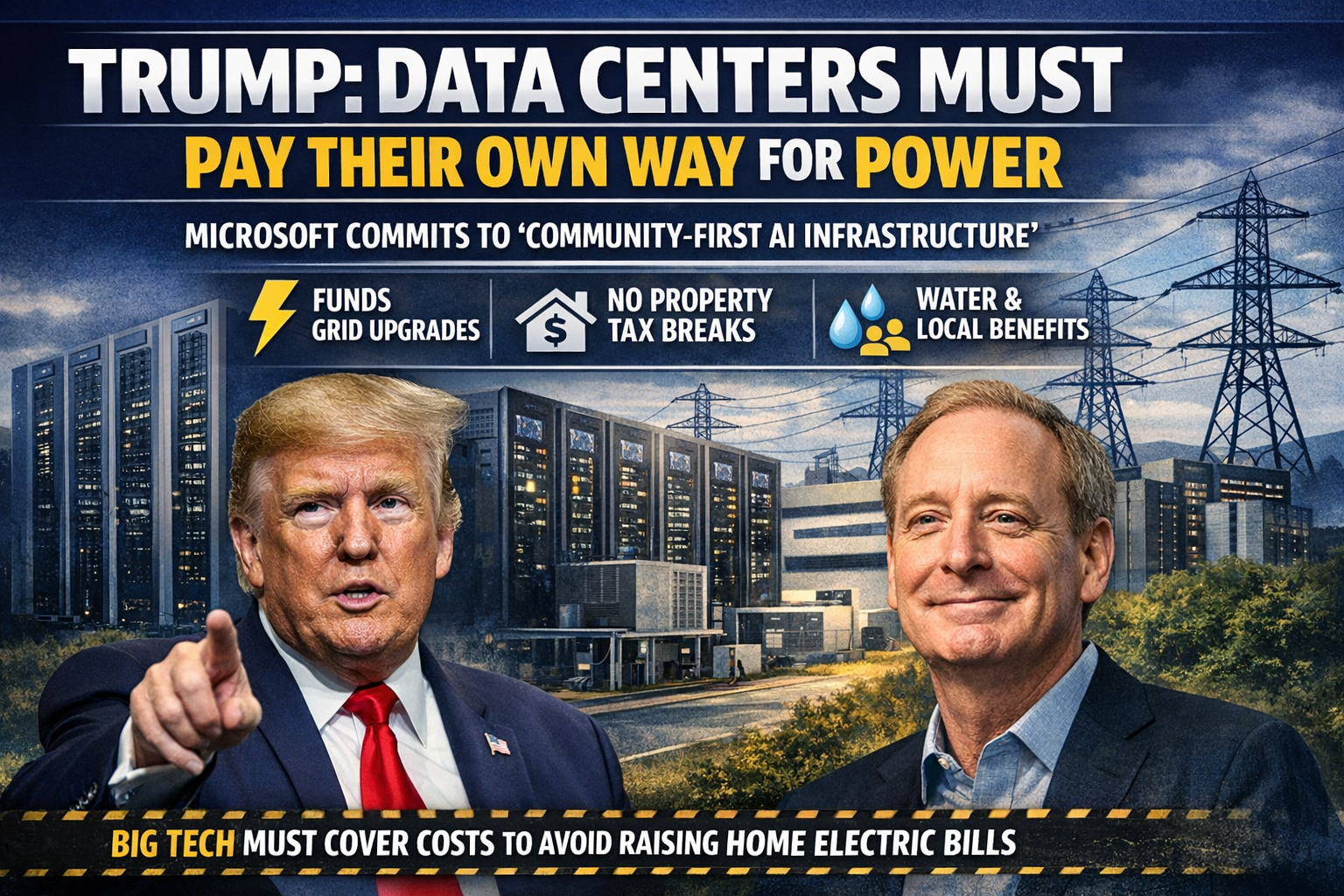
Maxim U.S. President Donald Trump said his administration is seeking formal commitments from major data center operators to ensure that the rapid expansion of AI infrastructure does not lead to higher electricity bills for households. As power demand surges alongside AI development, the White House position is that large technology companies should bear the costs associated with the additional strain they place on the grid. Microsoft has become the first hyperscale operator publicly identified as agreeing to this approach.

Microsoft President Brad Smith announced a new initiative called “Community-First AI Infrastructure,” which is intended to address mounting local resistance to AI data center development. A central component of the initiative is a commitment that Microsoft will fund its proportional share of electricity infrastructure costs so that its facilities do not increase residential power rates. The company stated it would cover necessary grid and utility upgrades linked to its projects.
In addition, Microsoft said it will not request reductions in local property tax rates associated with data center development and will instead pay what it described as its full and fair share. The company also outlined environmental and community commitments, including efforts to reduce water consumption and replenish more water than it uses, along with job creation, investment in local economies, and AI skills training programs.
The broader significance of Microsoft’s position lies in what it suggests about the future regulatory direction for large AI-driven power loads. Policymakers appear increasingly focused on ensuring that the costs of grid expansion are borne by the companies driving demand rather than being distributed across residential ratepayers. If this principle becomes standard practice, data center development may increasingly prioritize locations with existing power availability, and operators may rely more heavily on dedicated generation or firm power contracts to control costs and timelines.
However, important details remain unresolved. No financial figures have been disclosed, and it is unclear how this approach will interact with existing incentive programs. It is also uncertain whether companies that decline to adopt similar commitments would face penalties or other regulatory consequences.
Refernce :